
Owning a home in Fort Myers, FL means enjoying one of the best outdoor living climates in the country — and also dealing with one of the most demanding environments for home hardware. Salt air blowing in from the Gulf, humidity that rarely dips below 60%, intense UV radiation, and the annual threat of hurricane-force wind-driven rain all conspire to degrade sliding door systems faster than anywhere in the continental United States.
The good news is that a consistent maintenance routine — most of which takes less than 30 minutes twice a year — can extend the life of your sliding door rollers, tracks, weatherstripping, locks, and glass by years. This guide from Campbell Brothers Fort Myers Sliding Door Repairs walks you through exactly what to inspect, what to clean, and what to leave to the professionals.
Understanding Why Fort Myers Is Hard on Sliding Doors
Before diving into the checklist, it helps to understand what's actually attacking your door hardware so you know which components deserve the most attention.
- Salt air corrosion: Even miles from the beach, Fort Myers air carries enough salt particulate to accelerate oxidation on aluminum tracks and steel roller axles. You'll see white oxidation buildup on tracks and orange rust staining on steel components.
- UV degradation: Florida's solar intensity destroys rubber, foam, and vinyl seals faster than virtually any other climate. South- and west-facing doors that get direct afternoon sun are especially vulnerable to weatherstripping breakdown.
- Humidity cycling: Daily swings between air-conditioned indoor air and outdoor humidity cause wood door frames to expand and contract, aluminum to fatigue, and nylon roller wheels to soften and deform under load.
- Hard water mineral deposits: Many Fort Myers homes are on well water or have high-mineral municipal supply. When irrigation systems or rain spray tracks, mineral deposits accumulate in the roller channel and create abrasive buildup.
- Hurricane season: Wind-driven rain at 60–100+ mph pushes water past degraded weatherstripping and stresses door frames, while debris impacts can bend tracks and crack glass panels.
Your Twice-Yearly Sliding Door Inspection Checklist
Perform this inspection in spring (before hurricane season) and in fall (after hurricane season ends). It covers every major component in your sliding door system.
Step 1 — Inspect and Clean the Track
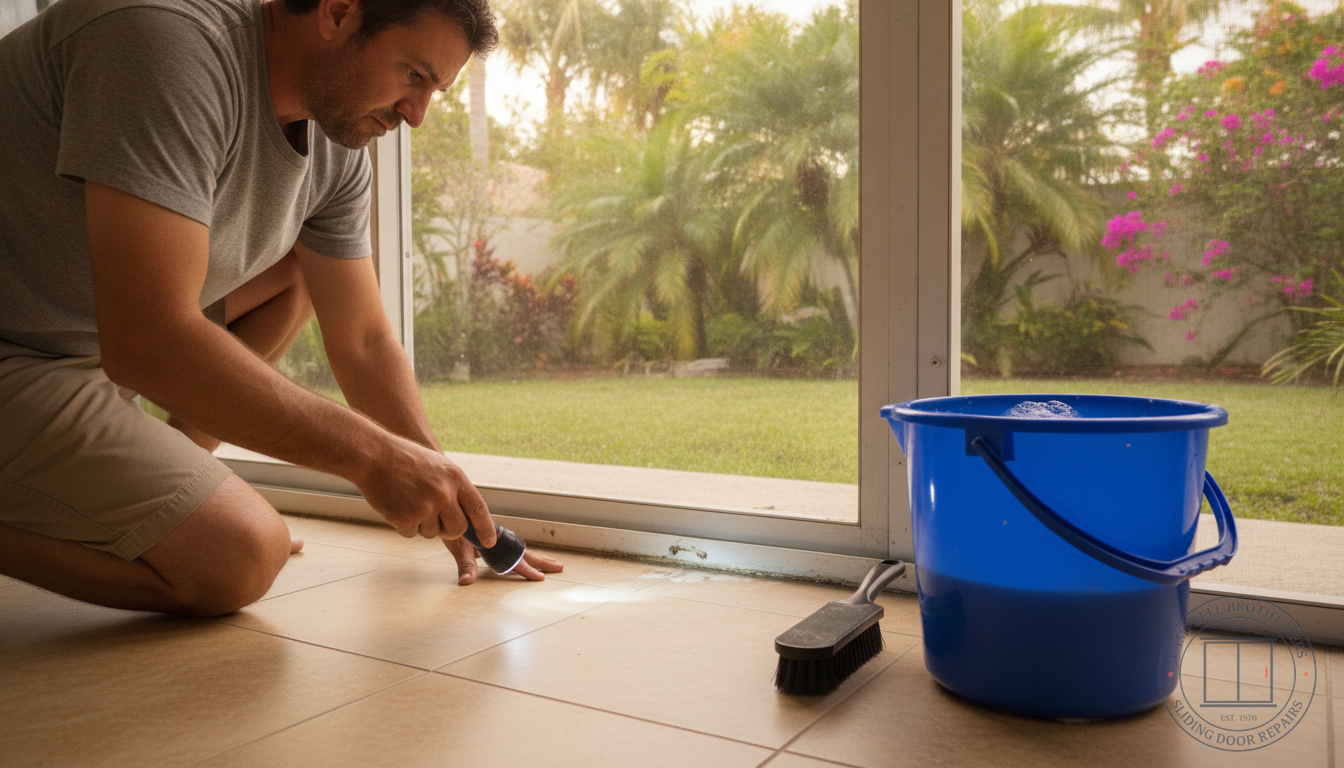
The bottom track is the component most exposed to debris, water, and foot traffic. Start by vacuuming or brushing out loose dirt, pet hair, and sand from the channel. Then mix a few drops of dish soap in warm water and scrub the channel with a stiff-bristle brush, paying attention to the roller contact surface along the bottom of the channel.
After cleaning, look for:
- Dents or crushed sections in the track walls
- White or orange corrosion pitting on the metal surface
- Sections where the channel floor appears uneven or bowed
- Hard water mineral deposits that didn't scrub off easily
Minor corrosion can be treated with a non-corrosive track lubricant (silicone spray is acceptable here — avoid oil-based products that attract dirt). Significant pitting, bending, or mineral buildup that won't clear means it's time to call for professional track repair or replacement. Left unaddressed, a rough track surface grinds roller wheels flat in a fraction of their normal service life.
Step 2 — Test and Examine the Rollers
Slide your door fully open and fully closed several times, paying attention to how it feels and sounds. A healthy door should glide with light finger pressure and make minimal noise. Note any of the following:
- Grinding, scraping, or clicking sounds during operation
- The need to lift the panel to get it moving
- The door rocking or wobbling side-to-side as it slides
- The panel dropping at one corner when you stop moving it
If your door has accessible roller adjustment screws at the bottom corners of the panel (most aluminum-framed doors do), use a Phillips screwdriver to test whether the rollers are at the correct height. The door should roll freely with roughly 3mm of clearance from the track floor at the wheel axle height — not resting directly on the track bottom, but not so high that it rocks.
Visible wear, flat spots, or rollers that won't turn freely when the door is tilted off the track are clear signs you need roller replacement. In Fort Myers homes, we generally recommend proactive roller inspection every three years for doors that see heavy daily use.
Step 3 — Inspect the Weatherstripping
Weatherstripping is your door's primary defense against hot air infiltration, water intrusion, and noise. Run your hand slowly along every edge of your door panel — top, both sides, and especially the bottom sweep — feeling for gaps, hardened sections, or areas where the material has pulled away from its channel.
Then close the door and check from the inside during daylight: any visible light around the perimeter indicates a sealing failure. Also inspect the interlock seal where two door panels meet at the center — this is a frequently missed leak point.
UV-hardened pile weatherstrip that has lost its loft, crumbling foam seals, and rubber compression seals with cracks or permanent compression sets all need replacement before hurricane season. Fresh weatherstripping from our weatherstripping replacement service keeps Fort Myers storm rain where it belongs — outside. Residents in canal-front communities like Whiskey Creek are especially vulnerable to water intrusion during heavy rain events due to wind channeling along the water.
Step 4 — Test the Lock and Latch
Lock and unlock your door ten times in a row. The latch should engage fully and release cleanly each time with no need to lift the door or push the panel inward to make the hook catch. Test any keyed lock cylinder for smooth rotation and confirm the thumb turn moves without resistance.
A latch that requires door-lifting to engage almost always indicates both roller wear (causing the panel to sag) and keeper misalignment — two issues that compound each other. Our lock repair and replacement service addresses both the mechanical latch and the alignment issue simultaneously for a lasting fix. Pool-enclosure sliding doors in homes throughout Lee County should also have their foot-bolt and child-safety locks inspected at every maintenance interval.
Step 5 — Examine the Glass
Look at the glass from several angles in good light. Fogging or haze between the panes of an insulated unit indicates a failed perimeter seal — this cannot be fixed by cleaning and will progressively worsen your home's thermal performance until the glass unit is replaced. Look also for hairline cracks, especially in the lower corners of the panel where stress concentrations are highest and where impacts from track debris are most likely.
Cracked sliding door glass is a safety hazard — tempered safety glass is designed to shatter into small pieces rather than large shards, but a crack compromises that behavior. Our glass replacement service sources correctly specified insulated, tempered units matched to your door and completes most replacements in a single visit once the glass is on hand.
Step 6 — Check the Screen Door
Sliding screen doors take a beating in Fort Myers from insects pushing against the mesh, pets scratching and lunging, and wind cycling that stresses the spline groove. Check the mesh for tears, holes, or sections that have pulled out of the frame groove. Examine the frame for bends, especially at the corners where miter joints can separate. Test the screen door rollers and top guide by sliding the screen fully open and closed.
Torn mesh can be re-screened in the existing frame if the frame is straight. Bent or separating frames need replacement. Our sliding screen door repair service covers both scenarios, including pet-resistant and solar-screen fabric options popular with Fort Myers homeowners who want to reduce lanai heat gain.
Maintenance Tasks by Season
- Spring (April–May): Full inspection per checklist above; replace weatherstripping if degraded; lubricate track; test all locks before storm season begins.
- Summer (June–September): After major storms, check track for debris and dents; inspect glass for stress cracks; verify latch still engages correctly after any wind loading.
- Fall (October–November): Second full inspection; check roller wear with the additional miles of operation accumulated over summer; re-screen any damaged screen doors before the pleasant-weather months when you'll use them most.
- Winter (December–March): Fort Myers's dry season is ideal for hardware work — lower humidity means adhesives, glazing tape, and weatherstrip adhesives cure faster and bond more reliably.
When Maintenance Becomes Repair
If your inspection reveals any of the following, schedule professional service rather than continuing to defer: rollers that are visibly flat or cracked, track sections that are bent or deeply pitted, weatherstripping that has fully separated from its channel, a latch that fails to engage more than once out of ten tries, or glass with any crack or persistent fogging between panes.
Campbell Brothers Fort Myers Sliding Door Repairs serves all Fort Myers neighborhoods — from Page Park and McGregor to North Fort Myers and Tice — seven days a week from 8:00 AM to 6:00 PM. We're located at 9160 Forum Corporate Pkwy, Suite 352, Fort Myers, FL 33905.
Call +12395395362 or email [email protected] to book a maintenance inspection or repair service. Staying ahead of sliding door wear in Fort Myers isn't just about convenience — it's about protecting your home's energy efficiency, security, and structural integrity through every Florida season.
Confirm Availability
Call +12395395362 or fill out our online form for a free, no-obligation quote.
Request Free Quote